What Started it All for Canadian Classic Airlines..... |
|
CP Air Virtual AirlinesClick Picture to Enter |
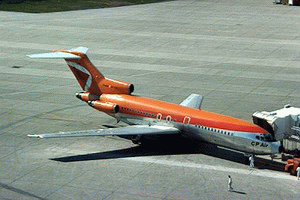
CP Air, formed as Canadian Pacific Airlines in 1942, began operations with Canadair C4 Argonauts and then DC6s. In 1958 the airline replaced these types with Bristol Britannia turboprops. It entered the Jet Age in 1961 with the arrival of three Douglas DC8s, which became the fleet standard for the 1960s and early 1970s with DC8-40s and DC8-63s. The DC8-63 stretched jets were introduced in the colourful orange/red livery which covered the fusalage top and fin with the fusalage underside in silver. CP Air was created in 1968 by the renaming of Canadian Pacific Airlines. The parent company - Canadian Pacific Corporation - had decided to align the airline's name and color scheme to that of it's other subsidiaries - CP Hotels, CP Rail, etc. Boeing 727s and 737s were used for non-transatlantic routes. From 1979 DC10-30s were used on the Gatwick route alongside Boeing 747-200s. CP Air 'merged' along with many other airlines in Canada to form Canadian Airlines International. |
Other Canadian Airlines that had some association with CP Air........ |
|
Eastern Provincial Virtual AirwaysClick Picture to Enter |
Eastern Provincial Airways began operations from St. John's, Newfoundland in 1949. Early services, like those of MCA, included a mixed bag of ambulance and mail services, cargo, charters, and forest and ice patrols - hardly a hint of the modern carrier that would emerge scarcely twenty years later. The company was founded with a Norseman aircraft by Eric Blackwood, a bush pilot and Royal Canadian Air Force veteran from World War II. Blackwood had the backing of St. John's businessman C.A. Crosbie. The purchase of a PBY Canso in 1953 allowed EPA to larger charter jobs, and a converted Canso allowed water-bombing flights on behalf of the government.In 1954 EPA moved its headquarters from St. John's to the now bustling international aviation hub in Gander where EPA planes mingled with the likes of Pan American and BOAC en route to or from Europe. But EPA's work still consisted mostly of a wide variety of government contracts. In Gander, EPA set up administrative offices and a maintenance hangar and with the addition of larger Douglas DC-3s and Lockheed 10s, commenced regular passenger services between St. John's, Gander and Deer Lake in 1955-56. In addition to regional charter work, international projects were operated as well, including a contract beginning in 1958 to do extensive work in Greenland for the Danish government. In 1960, regular passenger services began to Wabush and Twin Falls in Labrador. Curtis C-46s were leased for the routes with the first Handley Page Dart Heralds bought in 1962. In 1963, EPA purchased MCA and the two companies merged to form Eastern Provincial Airways (1963) Limited. The amalgamation allowed for a strong regional carrier to compete against government owned Trans Canada Airlines (later Air Canada). The mixed-bag operation continued until 1970. The sixties saw EPA operate a varied fleet of 36 aircraft, including four forty-six passenger Handley Page Heralds, six PBY Cansos, two Curtis C-46s, two Sikorsky S-55 helicopters, one Douglas DC-4, five DC-3 workhorses, and a few other smaller aircraft. The airline had a distinguished decade with work in India and Pakistan and the enjoyed the novelty of being the first Canadian airline in the new Soviet bloc Eastern Europe when EPA operated a cargo charter into Czechoslovakia. By 1970, EPA had started to resemble a modern airline. That year, EPA's "bush" operations were sold to some senior staff as a separate airline - Labrador Airways, now known as Air Labrador. EPA decided to standardize on the new Boeing 737 in the 1970s. The airline acquired seven of the jets from Boeing. The same color scheme that EPA had developed in the sixties was adopted for the planes. They were painted in white with a silver belly and an orange stripe along the window line. The orange gander logo was put on the tail, and the nose cone was painted black. Inside, passengers sat in flower patterned seats of various colors of purple, orange, and yellow - fashionable colors in the 1970s indeed. EPA expressed an intent in the early seventies to have an all-jet fleet as soon as it was practically possible. As it turned out, this was never to come to pass. EPA entered the seventies with three Handley Page Heralds and two DC-3s. The Heralds were responsible for flights into Iles-de-la-Madeleine, Quebec and Charlo, Chatham and Fredericton, New Brunswick until 1974 when they were sold to British Air Ferries. EPA started jet service into the northern New Brunswick cities while a Hawker-Siddeley 748 was acquired to replace the Heralds on the flights to Iles-de-la-Madeleine. 1972 and 1973 were good years for EPA. The number of passengers carried grew dramatically every year from 1969 until 1973. The company expanded, starting jet services into Saint John and Fredricton (New Brunswick) and Stephenville, Newfoundland. New employees were hired and EPA was successful in obtaining a Foreign Air Carrier Permit for the United States. EPA had interest in Sydney to Boston and Halifax to Portland and Bangor, Maine, but these routes never materialized. Instead, the company began to fly charters to Florida and the Caribbean in 1974. Negotiations were begun with de Havilland Canada and the Canadian federal government for a subsidiary carrier to operate using de Havilland Dash 7s. The Canadian federal application for the new service was rejected two years later and although the company renewed the application in 1977, Atlantic Canada wouldn't see Dash 7s until the mid-eighties when deregulation of the Canadian Aviation industry allowed for the Canadian Pacific feeder carrier Air Atlantic. 1975 was the first year EPA had a loss since entering the jet age in 1969. Over-capacity was partly dealt with by leasing 737s for six month periods to Wien Air Alaska, Aloha Airlines, and Aer Lingus over the next couple of years. The airline's DC-3s were operated on the Gander-St.Anthony-Goose Bay and Sydney-St.Pierre routes until 1975 when the St. Anthony service was taken over by another carrier and early in 1976 the St.Pierre route was upgraded to a Hawker-Siddeley 748. The DC-3 were disposed of -- the last piston engined aircraft in EPA's fleet. In 1981 and 1982, EPA acquired three more of the rugged Hawker-Siddeley 748s from Austin Airways, Ghana Airways, and COPA of Panama. These planes were used to feed jets services on flights from Moncton, New Brunswick, Charlottetown, Îles-de-la-Madeleine and to Saint-Pierre and Miquelon. In 1982 EPA set up Air Maritime as a wholly owned subsidiary to operate the 748s. EPA's headquarters were moved from Gander, now no longer a major aviation center, to Halifax. This allowed EPA to make Halifax a hub of operations and when schedules were coordinated with CP Air in 1983, Halifax became the main point of transit for passengers connecting from points further west to various places in the Maritimes and Newfoundland. By that time, EPA flew throughout Newfoundland, Nova Scotia, New Brunswick, and Prince Edward Island as well as far west as Montreal, Ottawa and Toronto. EPA introduced a new color scheme in the early eighties as well. Gone was the orange, replaced by a more up to date large navy blue "EPA" painted on the side of an all white side with the white gander on a blue background on the tail. Inside the 70s flower print seats were replaced by a more subtle beige with blue and red triangles. The 1980s and deregulation meant dramatic changes for Canadian airlines, including EPA. By 1984, EPA had entered into a strategic alliance with CP Air of Vancouver. CP lacked a Canadian route network east of Montréal and EPA's Atlantic province network complemented CP very well with Toronto and Montréal acting as connecting hubs. Soon afterwards, CP bought EPA and by 1986 EPA was no more as its operations were merged into CP Air. A new corporate personality soon was unveiled for CP with the resurrection of the Canadian Pacific Air Lines name and a modern blue, white and red color scheme. ( History information Courtesy of: Wikipedia - http://en.wikipedia.org/wiki/Eastern_Provincial_Airways ) |
Welcome to Wardair Virtual AirlinesClick Picture to Enter |
Wardair provided domestic service in Quebec, Manitoba, Ontario, British Columbia and Alberta, as well as international service to Europe, the USA, and several Caribbean and South American countries. On March 31, 1989, the Canadian Transportation Agency approved the sale of Wardair to Canadian Airlines International. Wardair had its roots in the air charter business in the Yukon and the Northwest Territories. From a modest start with small biplanes as a passenger and cargo charter company, the airline expanded into the more populous regions of Canada and turned into a holiday charter airline, from 1962 onwards. Wardair was not a discount airline but an airline providing good service at lower-than-average prices. They were known for high quality meals and friendly staff. "Steak & Champagne" flights was a popular advertising tag line in the 1980s, and won various awards from magazines for their service (Holiday Which? magazine charter airline of the year 1985, and scheduled carrier of the years 1986 and 1987). The operations from the early 1950s were small bush-type runs based in Edmonton, Alberta. and Yellowknife, NWT. Wardair's first large aircraft was a DC-6B, leased in summer 1962, which started the airline's emphasis on charter flights — to Europe in summer and to Mexico, California, etc. in winter. The first jet was a Boeing 727 (Canada's first Boeing) in 1966, the first Boeing 707 (allowing non-stop flights to Europe) in 1968, and the first Boeing 747 Jumbo Jet in 1973. Although initially centered on Edmonton, the long-haul flights were moved to concentrate on Vancouver and Toronto as their main origins, also serving other major Canadian cities. Hawaii became a significant winter destination, and London Gatwick a major summertime one. The 1970 mainline fleet consisted of two 707s and one 727; in 1980 it was four 747s and two DC-10s. Wardair was a small, steady-growing company. In 1987, from a fleet of seven jets, Wardair undertook a major expansion, ordering 38 aircraft: 14 A310, 12 MD-80 and 12 Fokker F100 - an exponential expansion of operations that would ultimately prove unsustainable. Only the first 12 A310s had been delivered — the remaining A310, MD-88 and Fokker F100 deliveries were cancelled after the takeover. The airline changed from charter to scheduled service in 1986. Rapid expansion, problems with their computer booking system, and failure to attract business customers, who had developed customer loyalty to frequent flier programs on competing airlines, led the airline into financial difficulties, ultimately resulting in the sale to Canadian Airlines in 1989. ( History information Courtesy of: Wikipedia - http://en.wikipedia.org/wiki/Wardair ) |